
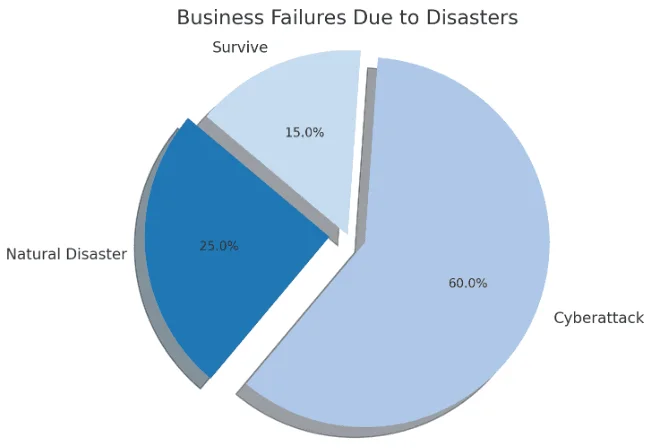
For New Jersey businesses, disaster recovery planning has to cover storms, power outages, hardware failure, ransomware, vendor outages, and accidental data loss. After a natural disaster, 25 percent of businesses never open again, while 60 percent of small businesses fail after a cyberattack. The common gap is usually the same: no tested plan before the emergency.
Whether you are preparing for a natural disaster or a human-made crisis, disaster recovery planning helps you keep data, operations, and customer communication intact. Here are seven steps you can take right now to make recovery faster and less chaotic.
Key takeaways
- After a natural disaster, 25 percent of businesses never reopen, and 60 percent of small businesses fail after a cyberattack.
- The survivors share one habit: they planned for the worst-case scenario before it arrived.
- A real plan covers communication lines, current contact information, protected records, and hardened digital defenses.
- Know your financial relief options in advance and keep the documentation insurers will ask for.
- Recovery speed is decided long before the emergency: test the plan and keep it current.
Keep (multiple) lines of communication open

When a storm wipes out power or a cyberattack shuts down your website and email, how do you stay in touch with clients and employees? Answer that question now, and you can keep communication flowing during a crisis in the future.
The key to keeping the lines of communication open during an emergency is to use many different channels. Include email, texting, and social media in your communication plan. In an emergency, chances are high that at least one channel will be available, even if others are offline.
Keep contact information current
In order to quickly reach out to the right people, you need to keep a list of current contact information for everyone you will need to talk to during an emergency. You should also create, write down, and educate stakeholders on clear communication protocols. When everyone knows what to do and possesses the tools to talk to each other, your business is able to quickly share information throughout any crisis.
Lock down critical data and records

If you do not have data, you do not have a business. Water or fire can consume physical records, while hackers can eat away at your digital data. Put your important information out of their reach to keep your New Jersey business safe in any emergency. Here are some tips for locking down critical data and records BEFORE disaster steals them.
- Back up documents regularly.
- Store physical duplicates off-site.
- Store digital duplicates on the cloud.
- Secure key documents (e.g. Tax returns, deeds, titles, insurance policies) in waterproof and fireproof safes.
- Take pictures or videos of high-value documents and equipment for easier disaster recovery.
Fortify digital data with IT and data recovery defenses
Every hour of downtime could cost your business thousands. Stop it before it starts with modern, state-of-the-art IT and data recovery defenses. Here are some of the bricks in an impenetrable digital defense.
- Modernize your IT infrastructure to protect your company's hardware, software, and data.
- Implement state-of-the-art security measures.
- Follow current best practices for disaster prevention and recovery.
- Train employees on data protection and disaster recovery procedures.
- Implement protocols for backing up data, recognizing cyber threats, and executing disaster recovery plans.
- Regularly test your disaster recovery plan.
- Identify and correct any weaknesses in the plan.
Know your financial relief options
In the aftermath of a disaster, you have to have financial stability. Do not spend time looking for financial relief options. Educate yourself about them before the crisis hits. Here are a few suggestions to get you started:
- Learn how to file insurance claims.
- Collect and secure important documents.
- Create a list of low-interest disaster recovery loans from the Small Business Administration (SBA).
- Learn how to apply for tax relief.
Plan to be an open book

Effective communication is critical in the aftermath of a disaster. Plan to maintain open channels with both employees and customers, keeping them informed about the recovery process. This transparency helps build trust during an uncertain time.
Reassuring employees about the company's plans to resume operations is just as important. That means you must first have a plan and then be able to communicate it. Knowing that you have a plan that you are actively implementing can help them feel safer during the upheaval of a crisis. Set yourself up now as an honest, straightforward business, and maintain that reputation to gain that most important element in business success: Trust.
Go with the flow
Adapting to the changes in the business environment post-disaster is important for a swift recovery. Implementing flexible strategies and resuming operations in a limited capacity, if necessary, can help stabilize your business, and customers' faith in you.
Having a plan can give you structure to guide and stabilize your business after a disaster. Flexibility can help you navigate the obstacles, and changes, that often accompany these crises. Together, a plan and flexibility give you the resilience your business needs to keep you and your customers safe.
For a real example of recovery under pressure, see how Spot On Tech helped a 120+ user healthcare facility respond after ransomware reached every server and affected the backups.
Protect your New Jersey business from unexpected disasters with practical IT planning. At Spot On Tech, we understand the operational risks local businesses face and are here to help. Contact us to learn how.