
Most growing businesses end up with a pile of software that doesn't talk to each other. Sales lives in one system, accounting in another, support tickets in a third, and someone spends Friday afternoon copying numbers between them. System integration is the work of connecting those tools so information moves on its own.
What Is System Integration?

System integration means connecting your software applications and data sources so they share information automatically. When it's done well, people stop re-typing data, reports get more accurate, and adding a new tool doesn't mean creating a new island. For a growing business, that adds up quickly.
Breaking Down Silos
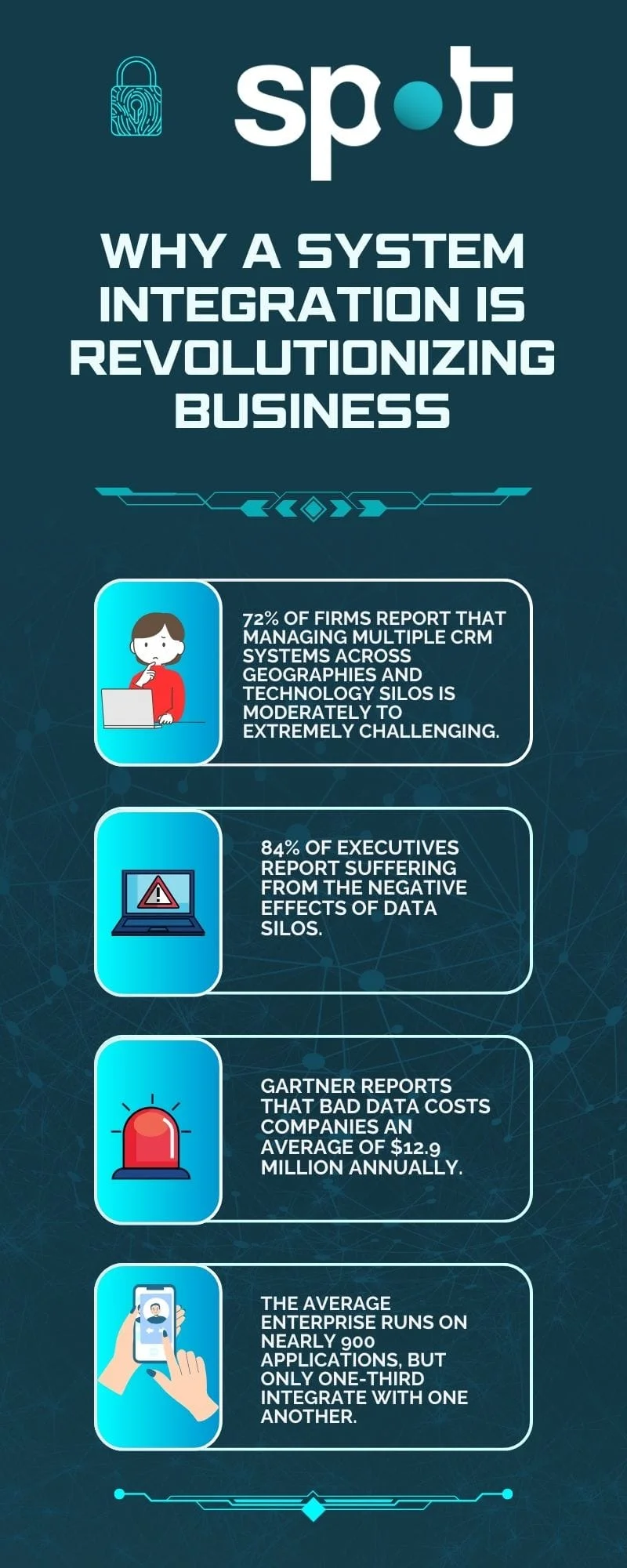
As companies grow, each department tends to pick its own tools. Before long, sales can't see support history, finance can't see what sales promised, and nobody has the full picture. That leads to duplicated work, slow decisions, and mistakes. Disconnected systems are also harder to secure and maintain, because each one has its own logins, updates, and vendor.
Integration fixes that by connecting the systems. Workflows that used to need someone to copy and paste can run automatically, and everyone works from the same up-to-date information.
More Accurate Data, Easier to Find
Every time a person moves data by hand, there's a chance of a typo, a missed update, or two versions of the same record. When systems are connected, that risk mostly goes away. Reports pull from the source, so the numbers leadership sees are the numbers the business is actually running on. Spot On Tech's Transparent Business Reporting is built on the same idea: accurate numbers in one place, explained in plain English.
It also saves time. Employees don't have to log into four systems to answer one question. The information they need is where they expect it to be.
One View of Each Customer

When sales, marketing, and customer service data live in connected systems, you can see everything about a customer in one place. That makes follow-ups faster and conversations more personal.
Think about a customer who calls with a problem. If the person answering can see every order, every past ticket, and every conversation with sales, they can help on the first call instead of transferring the customer around. That kind of service is what keeps customers coming back.
Lower Costs Through Automation
Integration also saves money. Automated workflows cut the hours spent on manual data entry, and accurate data means fewer costly mistakes. Once you can see where time and money are going, it's much easier to decide where to spend next. Most businesses make back the cost of a well-planned integration project through the time it saves.
There's a people benefit too. Nobody enjoys copying numbers between spreadsheets. When the repetitive work goes away, staff can spend their time on work that needs a human, and they tend to be happier for it.
Room to Grow
Your needs will change as the business grows. With a sensible integration plan, adding a new application or replacing an old one is a contained project rather than a months-long mess. You aren't locked into a tool just because too much depends on it.
That flexibility matters most when you're growing quickly. New locations, new services, and new staff all put pressure on your systems, and connected systems handle that pressure far better than a collection of standalone tools.
How Spot On Tech Helps With System Integration
Spot On Tech's Single Point of Tech model means one team looks after all of your technology. Because Spot On Tech already manages your systems, accounts, and security, we're in a good position to connect them properly and keep them working together.
What that looks like in practice:

- One team responsible: Your applications and the connections between them are managed by the same people, so there's no arguing about whose integration broke.
- Data that stays in sync: We set up and monitor the connections between systems, so information moves automatically instead of being re-typed.
- Security built in: Every integration is set up with proper access controls, and we keep an eye on it as part of your normal security monitoring.
- Room to change: When you add a new application or retire an old one, we plan the change so nothing downstream breaks.
- Lower running costs: Fewer manual steps and fewer overlapping tools mean less money spent keeping everything going. Spot On Tech looks for the overlap as part of every engagement.
If your team spends too much time moving information between systems, see how the Single Point of Tech works, or get in touch with Spot On Tech to talk about connecting your systems.