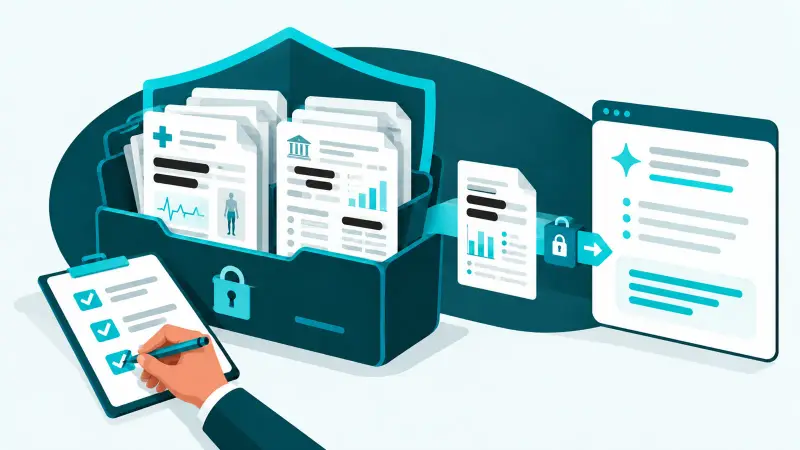
AI security for business comes down to six rules: approve the AI tools your staff may use, work only with vendors that protect your data, train people on safe use, check AI output before relying on it, follow the privacy laws that already apply to you, and keep a human voice on everything you publish. None of them require a large budget. Most start with a one-page policy.
Businesses are using AI to automate repetitive work, make decisions faster, and answer customers, usually faster than they write rules for it. In McKinsey's 2023 survey, only 21% of organizations had a generative AI usage policy, and Cyberhaven rated 71.7% of the AI tools it assessed as high or critical risk. Without some oversight, AI can open your company up to data leaks, compliance problems, and embarrassing mistakes.
1. Approve and secure your AI tools
AI systems should be treated like any other high-risk business technology. Not all employees need access to every platform, and unrestricted use can lead to data leaks or misuse.
What to do:
- Define which AI tools are approved for business use.
- Limit access based on role and responsibilities.
- Implement strong authentication, monitor usage, and audit activity logs regularly.
Why it matters: Unauthorized or unmonitored AI usage, often referred to as “shadow AI,” can result in sensitive data exposure, regulatory violations, or security breaches. Locking down which tools are allowed, and who can use them, keeps you in control of your data. It matters: one assessment of more than 700 AI tools found 71.7% were high or critical risk.
Tip: Integrate AI usage into your existing security and compliance monitoring tools to detect unusual behavior. Our shadow AI guide shows how to find the AI tools already in use, and our AI acceptable use policy template gives you the rules to write down.

2. Work only with AI vendors you trust
Many businesses sign up for AI tools without knowing where their data goes or how it's protected. That's a real privacy and compliance risk.
What to do:
- Vet all vendors thoroughly before integration.
- Ask about their data handling practices, encryption methods, and third-party audits.
- Favor vendors that meet recognized security standards like ISO 27001 or SOC 2.
Why it matters: Poor vendor controls can lead to unauthorized data sharing, legal liabilities, or even customer backlash. Your customers are aware of these dangers, as 75% feel that generative AI introduces new data security risks. Any AI vendor should be able to tell you plainly what they do with your data.
Tip: Ask vendors to provide documentation on their AI data lifecycle, including storage, retention, and deletion policies. If they can't or won't, pick another vendor.
3. Train your team beyond the basics
An AI tool is only as safe as the person using it. Human error is still one of the biggest risks when staff start using AI at work.
What to do:
- Offer regular training on how AI works, including how to spot bias, misinformation, and phishing attempts. This is critical because employees are three times more likely to be using Gen AI for their daily work than their leaders expect, meaning much of this usage is happening without oversight.
- Encourage employees to question unusual AI behavior.
- Make it clear where to go for help or to report concerns.
Why it matters: Staff who understand the tools make fewer mistakes, whether that's trusting a wrong answer or pasting in data they shouldn't.
Good to know: We offer customized employee security training that includes real-world simulations, ethical AI usage guidance, and practical threat detection.
Infographic
The AI Usage Disconnect
Employees using AI for over 30% of daily tasks: executive perception vs. employee reality.
4. Always check AI output
AI can generate emails, summaries, code, or reports instantly, but speed does not equal reliability. Unverified AI content can lead to serious business consequences.
What to do:
- Manually review AI-generated content for tone, factual accuracy, and alignment with your brand.
- Double-check outputs that will be shared externally, especially with clients or stakeholders.
- Treat AI as a creative assistant, not a final authority.
Why it matters: Mistakes or misinformation in AI content can lead to confusion, lost trust, or even legal consequences. Checking the output before it goes out catches most of these.
Best practice: Build a human-in-the-loop workflow for reviewing all public-facing or client-sensitive AI-generated content. If you use Microsoft 365, check what Copilot can reach before you turn it on; our Copilot readiness checklist covers it.
5. Follow the privacy laws that already apply
AI tools often handle sensitive or personal information, and the usual privacy laws still apply.
What to do:
- Check that your AI tools comply with laws such as HIPAA (for healthcare), GDPR (for EU data), and local privacy regulations.
- Stay updated on emerging AI compliance frameworks and evolving data governance rules.
- Document your internal policies governing AI use, including data retention, consent, and access controls.
Why it matters: Non-compliance with privacy laws and industry regulations can result in steep fines, lawsuits, or reputational harm. Writing down what staff may and may not do with AI is a cheap way to avoid an expensive problem.
Where to start: Begin with a cybersecurity risk assessment to identify gaps and strengthen your compliance posture.
Infographic
How Risky Are Workplace AI Tools?
Majority of AI tools used in the workplace that pose a significant data risk.
Infographic
The AI Policy Gap
Fraction of companies with established rules for generative AI use.
6. Keep a human voice on what you publish
AI can draft content quickly, but a person still needs to make it sound like you. Everything you send out reflects on your company, whoever wrote the first draft.
What to do:
- Review all AI-generated content for tone, clarity, and alignment with your brand.
- Make sure it sounds like your company.
- Avoid robotic, generic, or impersonal messaging in client-facing communications.
Why it matters: A consistent and professional brand image builds trust. Letting unchecked AI outputs slip through can make your business seem careless or detached.
Tip: Review AI-generated marketing content using a checklist for tone, formatting, brand consistency, and clarity before publishing.
Putting the six rules together
Getting AI right means balancing speed with responsibility. That includes:
- Protecting your systems and sensitive data through AI security best practices
- Embedding ethics and transparency into your processes
- Checking AI output before anyone relies on it
Do these six things and your team can get real value from AI without putting the business at risk.
Want help getting AI right?
Our AI governance service helps businesses adopt AI safely, from writing an AI policy and vetting vendors to training your staff and handling compliance. When you are ready to put approved tools to work, our AI implementation team helps your staff get real time savings from them. You can also request a cybersecurity risk assessment or schedule a consultation.
Call us at (862) 799-5100 or email our sales team.
Frequently asked questions
What is AI security for business?
It is the set of rules and controls that let a business use AI without leaking data, breaking privacy laws, or acting on wrong answers: approved tools, vetted vendors, trained staff, human review of output, and a written policy.
What is the biggest AI security risk for small businesses?
Employees putting customer, financial, or confidential information into AI tools the company has not approved. It is common, usually well-intentioned, and the information cannot be pulled back once it is shared.
How do I start securing AI use in my business?
Find out which AI tools staff already use, approve a short list on business plans, write a one-page acceptable use policy, and train the team on what data stays out of AI and how to verify urgent requests.
Do AI tools need to comply with HIPAA or other privacy laws?
Yes. Using AI does not change your obligations. If a tool will handle regulated data, it needs the same vendor review and agreements as any other system, such as a business associate agreement for health information.